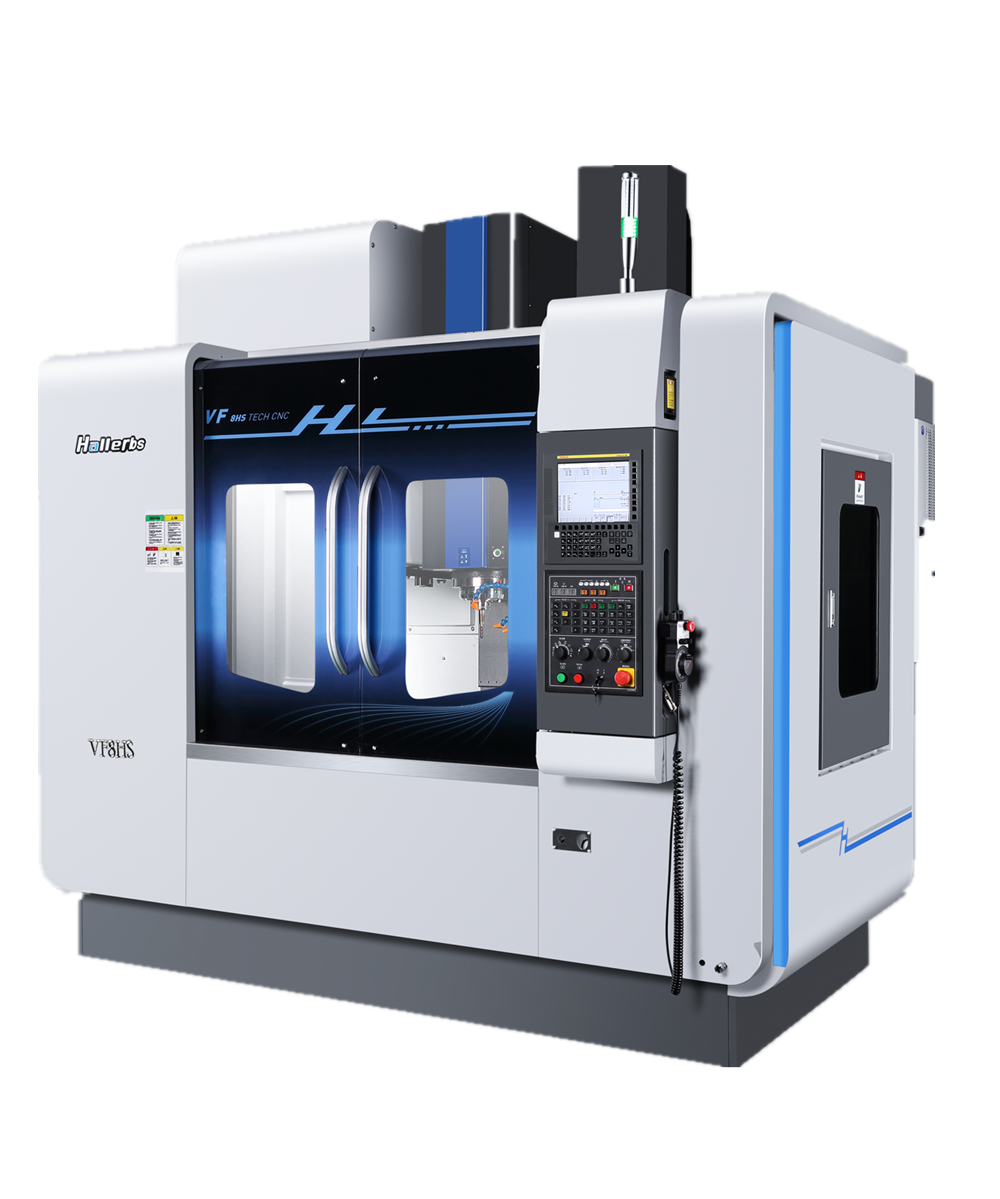
A construction-machinery manufacturer was losing time to slow positioning on a Taiwan-brand machine — long auxiliary (non-cutting) time on every control-box part. After switching to a HALLERBS HL-8, faster and more accurate positioning cut that dead time and lifted productivity about 20%, with better part quality too. Here is the part, the benchmark, the result, and why it worked.
How do you cut auxiliary (non-cutting) time on a machining center? With faster, more accurate positioning. On construction-equipment control-box parts, a HALLERBS HL-8 replaced a Taiwan-brand machine whose slow positioning created long auxiliary time. The HL-8's faster, higher-accuracy positioning cut that non-cutting time and raised productivity about 20%, with better part quality. It runs a BT40 12,000 rpm spindle and holds 0.006 mm to VDI 3441 over full travel. (We describe benchmark machines by origin and class rather than by brand.)
The parts are control-box / cabinet components for construction equipment — many features, lots of tool moves between them. On the incumbent Taiwan-brand machine, the cutting was acceptable but the positioning between features was slow, so auxiliary time piled up. On a feature-rich part, that hidden non-cutting time is often the real cycle-time problem.
The HL-8 is built for efficient machining of aluminium and steel parts, with positioning fast and accurate enough to cut the auxiliary time that dominated the incumbent's cycle.
Faster positioning between features attacks the exact non-cutting time that capped the incumbent — the direct source of the 20% gain.
More accurate moves mean less correction and rework — part quality went up alongside throughput.
A BT40 12,000 rpm spindle covers fast aluminium work and tougher steel features on the same machine.
Measured on the customer's live line, replacing the Taiwan-brand machine on the same control-box parts.
On a feature-rich part, the spindle is idle a lot — moving, changing tools, repositioning. The HL-8 wins by shrinking that idle time:
For the full engineering story — casting, cooling, FEM and the 14-point inspection — see how we build them.
Will I get 20% on my parts? It depends on how much of your cycle is non-cutting time. Feature-rich parts with many tool moves tend to gain the most. Send your part drawing and current cycle and our engineers will estimate the realistic gain.
Why not name the customer or the benchmark brand? Customer identities are withheld under NDA, and we describe benchmark machines by origin and class rather than by brand.
Do you support installation and training abroad? Yes — pre-sale design, on-site commissioning, operator and programming training, spares and remote diagnostics. See Service & Support.
Send your part drawing, current cycle time and volume — our engineers will model the realistic gain and propose the right machine and a quotation.