Chinese machine tools now compete with European, Japanese and US brands on accuracy — at a fraction of the price. The risk is no longer the machine; it is the process around it. This guide is the de-risking checklist export buyers actually need: how to verify accuracy, run a factory acceptance test, handle installation abroad, secure spares and support, and compare total cost instead of sticker price.
Is it safe to buy a CNC machining center from China? Yes — if you de-risk the purchase rather than rely on trust. The machines themselves are now benchmarked against top European, Japanese and US brands. What separates a good import from a bad one is the process: accuracy verified to a stated standard (VDI 3441), a documented in-process inspection, a factory acceptance test (FAT) before shipment, on-site installation and commissioning, operator training, a genuine spare-parts supply and remote diagnostics. Buy from a supplier that gives you one accountable line from part drawing to running machine, and most of the risk disappears.
Work through these in order. Each one converts a worry into a written commitment you can hold the supplier to.
Every HALLERBS machine is built on a flagship platform with German design and process, the core technology and casting formula bought out from the original German Haller (est. 1984), and verified before it leaves the plant.
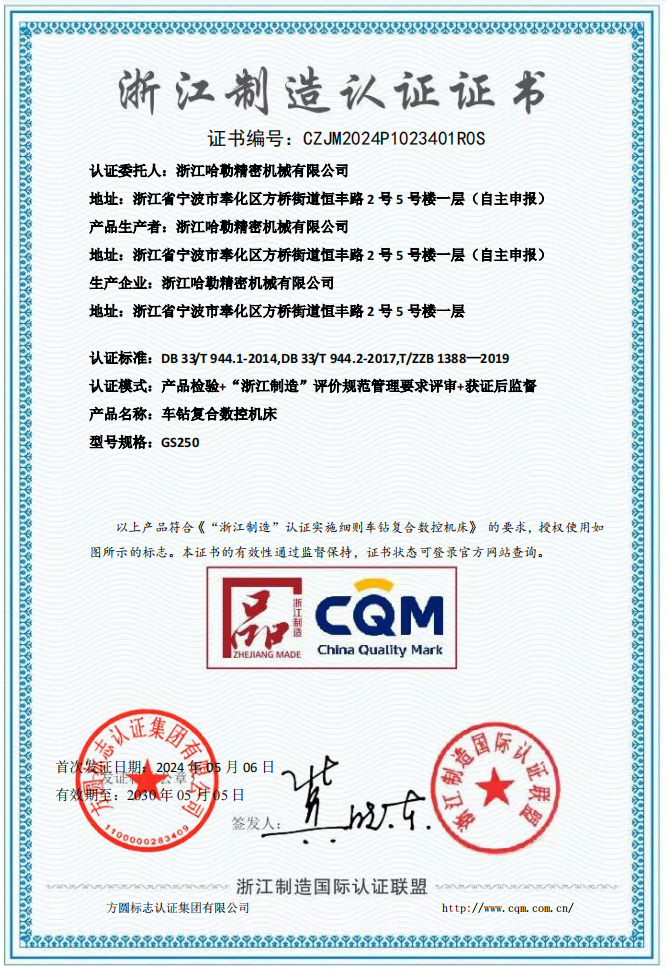
CE · High-Tech Enterprise · VDI 3441 test report — see Quality & Certifications. After shipment: on-site commissioning, training, genuine spares and remote diagnostics through an authorized global export partner.
Beyond the machine, the contract is where risk is shared. Settle these before you sign:
Agree the Incoterm (EXW, FOB, CIF or DAP) so responsibility for freight, insurance and customs is unambiguous. Heavy machine tools need crating, lashing and an experienced forwarder — confirm who arranges each leg.
Tie payment to evidence: a deposit, a balance against a passed FAT, and a retention released after on-site commissioning. Milestones aligned to verification protect you far better than a flat prepayment.
Get the warranty period and what it covers in writing, plus a realistic build-and-ship lead time. Build the FAT date and sea-freight transit into your project schedule from the start.
How should I compare cost — sticker price or total cost of ownership? Compare total cost per good part over the machine's life, not the purchase price. A HALLERBS machine typically costs 20–30% below an imported equivalent, but the real saving compounds through cycle time, uptime, spare-parts cost and the labour around the line. On one documented tier-1 automotive line, a HALLERBS machine cut cycle time on the same part from 11m 31s to 9m 25s — see the case studies. Send us your part and volume and our engineers will model the total cost with you.
What is a factory acceptance test (FAT)? A verification at the manufacturer's plant before shipment — confirming the machine meets spec on geometry, positioning accuracy (VDI 3441), spindle and axis function and control, ideally with a sample part to your drawing. A signed FAT protocol lets you accept the machine on documented evidence. You can attend in person or by live video.
How do I get spare parts and support abroad? Agree the scope before ordering. HALLERBS supplies genuine spare parts, remote diagnostics and technical support across time zones, with on-site service through an authorized global export partner. A mainstream control (Siemens / FANUC / Mitsubishi) keeps parts and expertise globally available.
Will my team be able to run and program the machine? Yes — operator and programming training on the actual control and your parts is part of the engagement. Choosing a control your team already knows shortens the learning curve further.
How accurate are Chinese-built CNC machines now? The right ones are benchmarked against top European, Japanese and US brands. HALLERBS machines hold accuracy to VDI 3441 — for example 0.005 mm positioning and 0.004 mm repeatability on the flagship platform — verified by test report and a 14-point inspection on every machine.
What lead time and logistics should I plan for? Plan for build time, a FAT date and sea-freight transit, plus customs clearance and on-site installation. Settle the Incoterm up front so freight, insurance and customs responsibility are clear. Our team scopes the full timeline with you before you commit.
Send your part drawing, target cycle time and volume. Our engineers propose the right machine, a verification plan (inspection, FAT, commissioning) and a quotation — or ask the assistant in the corner.